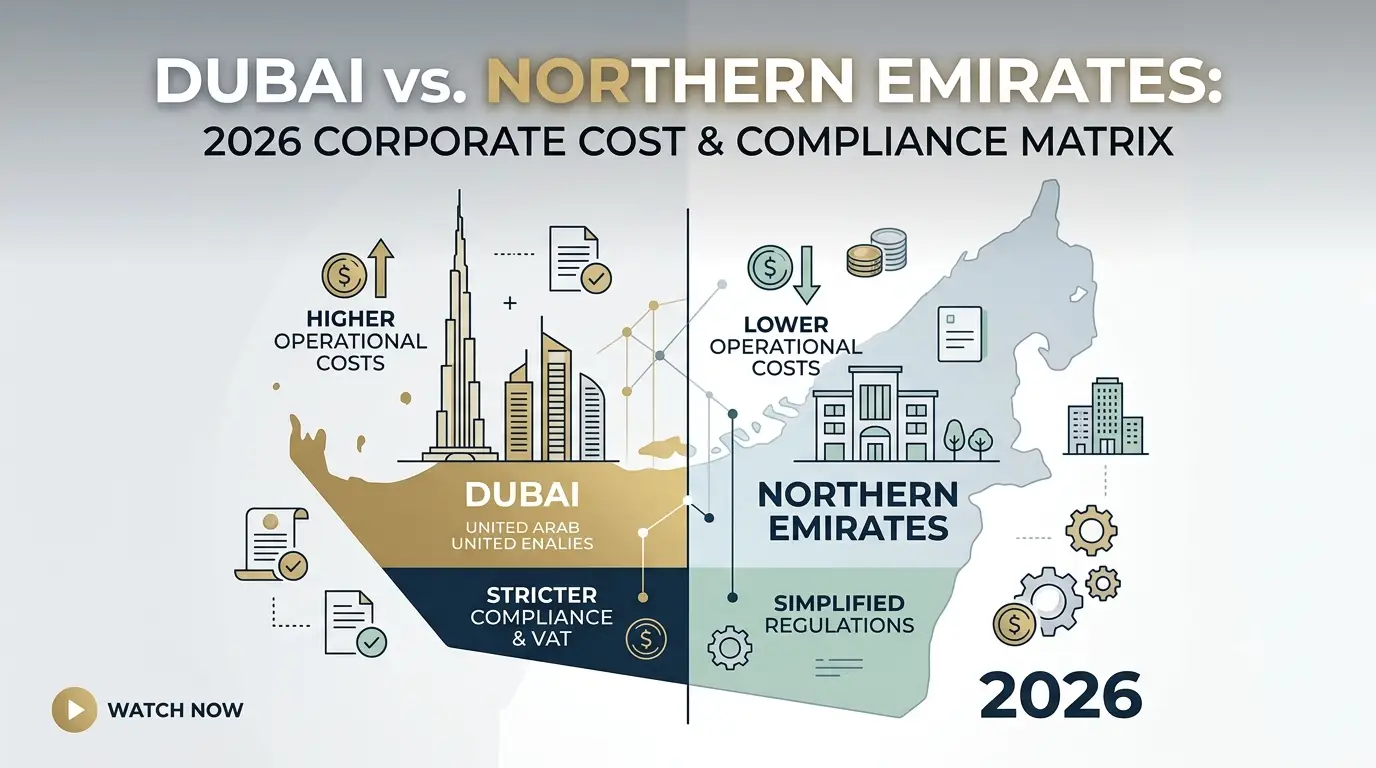
Macroeconomic Structural Briefing
For international business owners, global investors, and regional tech startups navigating the UAE market, selecting a corporate domicile is no longer a simple matter of comparing upfront trade license application fees.
In the 2026 fiscal year, the distinction between **Dubai Free Zones** (such as IFZA, Meydan, DMCC) and the **Northern Emirates** (Ajman NuVenture, SHAMS, RAKEZ) centers on operational lifecycle costs rather than baseline license prices. While Northern Emirates jurisdictions present the lowest initial setup fees—with entry-level consulting and e-commerce configurations starting as low as AED 4,888 to AED 6,000—the real cost optimization is dictated by corporate bank account minimum capital allocations, anti-money laundering compliance auditing under Federal Decree-Law No. 47, and eligibility for Qualifying Free Zone Person (QFZP) status.
Historically, the narrative surrounding corporate setup in the United Arab Emirates categorized the Northern Emirates purely as low-cost alternatives for small businesses and solo founders, while Dubai was designated as the high-premium hub for scalable enterprises. In 2026, this dynamic has been reshaped by massive regulatory overhauls across immigration digital platforms, corporate tax implementations by the Federal Tax Authority (FTA), and standardized commercial substance compliance parameters.
To truly understand where real cash retention happens over a three-to-five-year corporate operational runway, founders must audit everything from multi-tiered visa registration line items to physical real estate obligations. Making the wrong choice can trap an operational vehicle in a costly web of regulatory non-compliance, bank account freezing, and unexpected tax burdens.
The 2026 Quantitative Baseline Matrix
Before assessing the hidden infrastructural expenses, it is critical to observe the verifiable starting configurations available across the top free zone environments. These numbers reflect verified regulatory fees for the current 2026 operating framework.
| Jurisdiction Hub | Base License Fee (0-Visa) | Immigration Quota Scaling | Audited IFRS Statements | Banking Friction Coefficient |
|---|---|---|---|---|
| Ajman NuVenture (AFZ) | AED 4,888 | Up to 6 Visas per entity | Exempt unless electing QFZP | Moderate-High (Requires agent) |
| Sharjah Media City (SHAMS) | AED 5,750 | Up to 6 Visas per entity | Exempt unless electing QFZP | Moderate (Digital friendly) |
| RAK Economic Zone (RAKEZ) | AED 6,000 | Up to 13 Visas (Package linked) | Mandatory for industrial lines | Low-Moderate (Strong localized hubs) |
| Meydan Free Zone (Dubai) | AED 12,500 | Flexible / Scalable desk limits | Recommended for annual filing | Low (Highly automated via DED links) |
| IFZA Dubai | AED 11,900 | Up to 6 Visas (Flexi-desk variant) | Required for permanent records | Minimal (Preferred bank pathways) |
Deconstructing the Hidden Cost Drivers
The mistake most international business owners make is building their financial forecasts entirely around the data points in the second column of the table above. The real operational cost of a business is determined by subsequent requirements. Let us systematically break down the structural cost centers where savings are either achieved or lost.
1. The Reality of Visa and Immigration Line Items
A "zero-visa" license is ideal for a remote digital consultant who operates purely through a personal residency status elsewhere. However, if your business requires you to live in the UAE or employ human capital, the immigration fees must be evaluated with line-item precision. Government fees remain relatively consistent across the country, but administrative markups vary wildly.
When obtaining a standard partner, investor, or employment visa in 2026, you will encounter the following mandatory capital outlays:
- Establishment Card Activation: Ranging from AED 1,800 to AED 2,500 depending on the speed of the registrar portal. This card must be renewed annually or biennially.
- Entry Permit Processing: AED 1,200 to AED 1,800 for inside-the-country modifications, or slightly lower if processed while the applicant is outside the borders.
- Status Change Mechanism: If you are already physically in the UAE on a visit visa or tourist track, changing your status to a corporate structure incurs an administrative fee of AED 700 to AED 1,000.
- Medical Fitness Screening: VIP fast-track systems cost between AED 350 and AED 850, ensuring health authority clearance within 4 to 24 hours.
- Emirates ID Biometrics & Card Issuance: AED 370 to AED 570, scaling directly with the multi-year validity of the underlying visa allocation.
When you add the free zone authority's internal processing charges, a single residency visa totals between AED 4,000 and AED 6,500. Consequently, an entry-level license in SHAMS or Ajman combined with one visa shifts from an advertised AED 5,000 to a real operational investment of AED 9,500 to AED 11,500 before factoring in required health insurance coverage.
2. Corporate Bank Account Opening: The Real UAE Bottleneck
You can register a corporate entity in under 72 hours, but if that entity cannot open a corporate bank account, it is functionally useless. This is the single largest area where cost savings turn into losses. UAE commercial banks operate under strict regulatory compliance directives managed directly by the Central Bank of the UAE to meet international anti-money laundering standards.
When assessing an account application, compliance departments place significant weight on the entity's address and jurisdiction:
Dubai Domiciles: Entities with licenses from IFZA, Meydan, or DMCC pass through initial know-your-customer (KYC) algorithms with less structural friction. Banks recognize the premium paid for these licenses as a sign of legitimate, operational intent. Furthermore, many tier-1 banks (such as Emirates NBD, Mashreq, and Wio Bank) feature direct API integration with Dubai free zone databases, speeding up your verification timeline.
Northern Emirates Domiciles: While entirely legal and structurally sound, entities registered in remote free zones face much higher scrutiny during onboarding. Banks frequently demand highly detailed trade proof, signed contracts from existing international suppliers, and comprehensive bank statements from the founders' home countries.
The hidden cost lies in **Minimum Average Balance Requirements**. To open a traditional corporate account with zero friction, banks often require companies to maintain a minimum monthly balance ranging from AED 50,000 to AED 500,000. If your balance falls below this line, penalty fees are assessed monthly. While a Northern Emirates license saves you roughly AED 7,000 on day one, if it delays your corporate account opening by 4 months, the lost business momentum easily eclipses those initial savings.
For businesses looking to navigate these complex digital banking frameworks smoothly, leveraging expert guidance is essential. Review our technical breakdowns on AEY Corporate Structuring Services to discover how to align your jurisdiction selection directly with current bank compliance parameters.
Corporate Tax Optimization in 2026: The Ultimate Deciding Factor
The implementation of Federal Decree-Law No. 47 completely fundamentally changed the logic of UAE business setup. In 2026, corporate tax compliance is the single most important factor determining your long-term cost structures. The standard framework levies a 9% tax on net corporate profits that exceed AED 375,000. How this intersects with your choice of free zone determines your real fiscal liabilities.
The Qualifying Free Zone Person (QFZP) Trap
Every free zone in the UAE promises a 0% tax rate on corporate income. However, to actually secure that 0% rate, your entity must achieve status as a **Qualifying Free Zone Person (QFZP)** under strict Federal Tax Authority (FTA) guidelines. The conditions are precise and unforgiving:
- Adequate Substance Maintenance: The entity must prove its Core Income-Generating Activities (CIGA) are physically performed within the designated free zone boundaries. This requires having an adequate number of qualified local employees and incurring sufficient operating expenditures within the zone.
- Deriving Qualifying Income: The company's revenue must come from transactions with other Free Zone Persons, or from specific "Qualifying Activities" (such as wholesale international trading, logistical distribution, or intellectual property exploitation).
- The De Minimis Threshold: If your non-qualifying revenue (such as selling services directly to mainland UAE businesses without a local distributor) exceeds 5% of your total revenue or AED 5,000,000 (whichever is lower), your entire entity loses its QFZP status. Your whole profit pool is then hit with the standard 9% tax rate.
- Mandatory Audited Financials: Every single QFZP, regardless of its size, must submit audited financial statements prepared strictly under International Financial Reporting Standards (IFRS) alongside their annual tax filing.
This introduces a substantial recurring cost. Preparing annual IFRS-compliant audited accounts costs between AED 4,000 and AED 12,000 per year in professional auditor fees. If you opt for an ultra-cheap AED 4,888 Northern Emirates license but your business model requires QFZP registration, your compliance overhead instantly doubles your annual renewal costs.
Small Business Relief (SBR) Alternative
For smaller operational setups, freelancers, and growing consulting teams, a different strategic approach often yields far better cash flow. Under current provisions active through December 31, 2026, resident companies with gross annual revenues under **AED 3,000,000** can formally elect **Small Business Relief (SBR)**.
By electing SBR, your business secures a 0% tax rate on all net profits for that tax period without having to pass complex CIGA substance metrics or stick to restrictive "Qualifying Activity" lists. Crucially, SBR entities are often exempt from submitting full, audited financial records to the FTA, lowering their accounting overhead.
However, there is a catch: **Qualifying Free Zone Persons cannot elect Small Business Relief**. This is where advanced corporate structuring becomes vital. If you expect your business turnover to stay between AED 500,000 and AED 2,500,000, setting up your company in a flexible, service-oriented ecosystem like Meydan or SHAMS, and electing SBR, protects your bottom line far better than trying to meet rigid QFZP standards in a specialized logistics or industrial zone.
To evaluate your specific corporate structure and see if your setup fits the requirements for tax reliefs, review our comprehensive framework at AEY Structural Risk Analysis.
Strategic Setup Workflow: AEY Incorporation Protocol
To maximize initial capital preservation while ensuring long-term bank and tax stability, founders should follow this structured integration roadmap when establishing their UAE business footprint.
- Activity Isolation and Mapping: Audit your planned business activities against the specific regulatory databases of the target registries. Confirm whether your chosen activity requires approval from external government departments (such as KHDA for education, DHA for health tech, or the Security Industry Regulatory Authority for physical tech lines).
- Jurisdictional Value-Mapping: Evaluate whether your business model benefits more from the low initial entry cost of a Northern Emirates hub (e.g., SHAMS or RAKEZ) or if it requires the credibility and proximity of a premium Dubai Free Zone (e.g., IFZA or Meydan) for banking and local commercial operations.
- Immigration and Visa Allocation Planning: Calculate your immediate visa requirements. Structure your application packages to bundle the Trade License, Establishment Card, and your initial investor or partner visa fees together. This approach eliminates the separate administrative markups that registries often tack on later.
- Banking Architecture Blueprinting: Before filing your corporate documents with any registrar, draft your core customer agreements, prepare your business plan, and compile six months of personal bank statements. Aligning these documents with your target bank's compliance standards ensures quick account activation once your license is approved.
- Tax and Compliance System Alignment: Set up localized corporate governance and bookkeeping systems right from day one. This ensures you can easily track gross revenues against the AED 3,000,000 SBR limit or prepare your books for mandatory IFRS audits if you need to maintain QFZP status.
Jurisdictional Intelligence FAQ
From a strict regulatory standpoint, a free zone company is restricted to operating within its specific zone borders or internationally. If your Northern Emirates entity needs to sell physical goods directly into mainland Dubai, you must work with a licensed local distributor or set up a secondary dual-license branch with the Dubai Department of Economy and Tourism (DET). However, digital service providers, software-as-a-service (SaaS) platforms, and remote consultants can generally serve clients across all emirates seamlessly from a virtual or flexi-desk setup.
The Ministry of Economy and the Federal Tax Authority enforce substantial administrative fines for compliance delays. Missing your corporate tax filing deadline can result in immediate fines of AED 10,000 to AED 20,000. Similarly, failing to maintain an updated Ultimate Beneficial Owner (UBO) registry at your registered office can lead to suspensions of your trade license and restrictions on your corporate bank accounts.
Mainland corporate entities must maintain a physical office lease registered through the Ejari system to renew their licenses annually. By contrast, most free zones across both Dubai and the Northern Emirates allow you to renew your license using virtual office packages or shared flexi-desk spaces. This flexibility significantly reduces ongoing overhead costs for digital nomad operations and early-stage lean startups.
Deploy a High-Yield UAE Corporate Structure
Avoid the financial pitfalls of generic online packages. Work with the corporate structuring specialists at AEY Prime Ventures to map out an entity architecture customized for your business goals, banking preferences, and long-term tax compliance.
Schedule an Expert Consultation